In today's fast-paced business landscape, creating offerings that truly meet customer needs is not just an advantage—it's a necessity for survival and success.
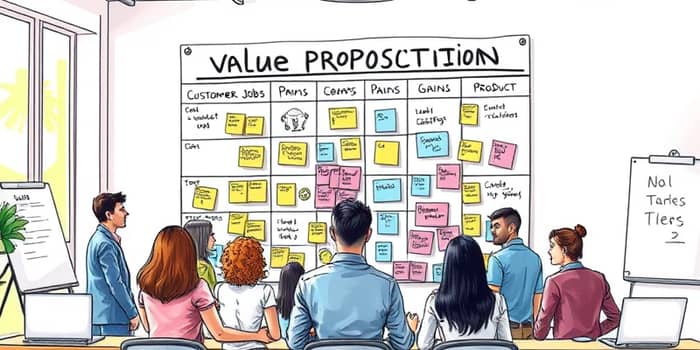
The Value Proposition Canvas (VPC) emerges as a strategic framework that bridges the gap between what businesses offer and what customers truly desire.
Developed by Alexander Osterwalder, this tool extends the Business Model Canvas to focus intensely on achieving product-market fit through a customer-centric lens.
At its core, the VPC is a visual tool designed to align your products or services with the specific needs and desires of your target customers.
It breaks down the complex process of value creation into manageable components, ensuring that every aspect of your offering is thoughtfully considered.
By mapping out customer profiles against value offerings, businesses can avoid the common pitfall of building products based on assumptions rather than evidence.
This approach not only enhances customer satisfaction but also drives loyalty and long-term profitability.
The VPC is structured around two main blocks: the Customer Profile and the Value Map.
Each block contains three key elements that work together to create a comprehensive view of value creation.
Starting with the Customer Profile ensures that your strategy is rooted in a deep understanding of your audience.
This customer-centric approach is crucial for identifying real opportunities and avoiding wasted resources.
It's essential to create one profile per customer segment to ensure precision and relevance.
The magic happens when pain relievers and gain creators align directly with prioritized pains and gains, creating a fit that drives success.
Using the VPC offers numerous benefits that can transform how businesses operate and innovate.
It shifts the focus from internal capabilities to external customer needs, fostering a culture of empathy and responsiveness.
This tool provides clarity and focus, helping teams communicate value effectively and prioritize features that matter most.
Consultants and executives alike use the VPC for product alignment, feature prioritization, and hypothesis testing, making it a versatile asset in any toolkit.
Implementing the VPC involves a structured, iterative process that relies on research and data.
Follow these steps to ensure a thorough and effective application, starting with one customer segment at a time.
This process should be supported by customer interviews, market data, and continuous feedback loops.
Testing with MVPs and experiments, such as landing pages or pilots, helps validate assumptions and refine offerings.
The VPC is an extension of the Business Model Canvas (BMC), zooming in on the value proposition block.
While the BMC provides a high-level overview of business strategy and operations, the VPC delves deeper into customer-value dynamics.
This relationship ensures that value creation is seamlessly integrated into broader business planning.
By aligning the VPC with the BMC, businesses can ensure that their value propositions support overall objectives like customer relationships and revenue streams.
The VPC is applicable across various contexts, from startups to large enterprises.
It helps refine existing products or build new ones from scratch, making it a flexible tool for innovation.
These examples show how the VPC translates abstract concepts into actionable insights that drive tangible results.
While the VPC is powerful, missteps can undermine its effectiveness.
Being aware of these pitfalls helps businesses maximize the tool's potential and avoid wasted effort.
By staying focused and iterative, businesses can leverage the VPC to create offerings that customers genuinely value and advocate for.
The Value Proposition Canvas is more than just a tool—it's a mindset shift towards customer empathy and strategic clarity.
By embracing its principles, businesses can navigate complexities with confidence, turning challenges into opportunities for growth.
Start using the VPC today to define your offering with precision and inspire a future where every product meets a real need.
References