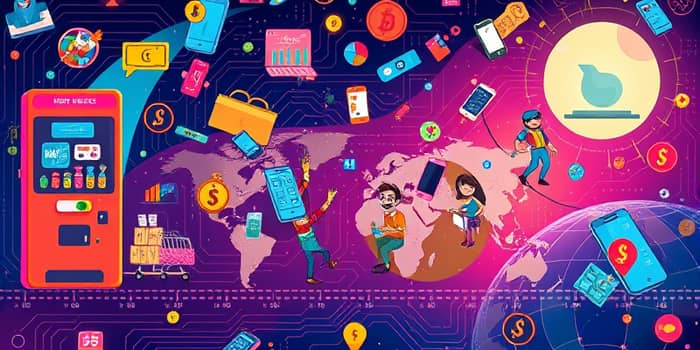
Over the past three decades, the way we handle money has undergone a radical transformation. From simple text message payments in Helsinki to today’s blockchain-powered platforms, digital wallets have rewritten the rules of commerce. This article traces the journey of these technologies, highlighting key milestones, market dynamics, and future trends that are shaping the financial world.
What began as a curiosity in the 1990s has grown into a cornerstone of the global economy. Today, more than 5.2 billion people use digital wallets, making these platforms one of the most widespread financial innovations in history. Let’s explore how we arrived here and where we are headed next.
The origins of digital wallets can be traced back to the late 1990s, when early experiments paved the way for modern solutions. In 1997, a Coca-Cola project in Helsinki showcased contactless payments merged seamlessly with vending machines. At the same time, the first online purchase—Sting’s album on NetMarket—demonstrated the potential of internet-based transactions.
Throughout the early 2000s, mobile money services and peer-to-peer platforms emerged. PayPal, launched in 1999, quickly gained traction by offering a convenient, secure alternative to traditional banking for online transactions. The introduction of M-PESA in Kenya in 2007 brought financial inclusion to millions who lacked access to formal banks, setting a powerful example for the world.
By the end of the decade, the integration of digital currencies marked a new chapter. Bitcoin’s arrival in 2009 introduced decentralized finance applications accessible without centralized authorities, reshaping expectations for financial autonomy and privacy.
As of 2025, digital wallets account for over 83% of global digital payment volume, processing a staggering $41 trillion in spending during 2024 alone. The Asia-Pacific region leads the charge, with $36.8 trillion in transactions—driven by Alipay and WeChat Pay—while the Americas contribute $2.2 trillion to the total.
In the United States, Apple Pay dominates with a 92% market share, handling an estimated $10 trillion annually. Its user base of 64 million Americans illustrates unprecedented global adoption rates of mobile wallet services. Google Pay, Samsung Pay, and a host of regional solutions complement this ecosystem, catering to diverse consumer preferences.
In e-commerce, digital wallets represent 39% of online transactions in the US and 16% of in-store purchases. Globally, usage is split almost equally between online (49%) and in-person (51%) payments, reflecting a versatile financial tool that adapts to varied spending habits.
The backbone of modern digital wallets rests on robust technology. Near-field communication (NFC) chips now enable transforming smartphones into financial hubs that can tap-and-go at countless retailers. Biometric authentication—using fingerprints and facial recognition—has strengthened security and convenience, with over $2 trillion of transactions protected by these measures as of 2023.
Blockchain and cryptographic techniques underpin many decentralized wallets, offering users unprecedented control over their digital assets. Platforms like MetaMask and Trust Wallet illustrate how secure biometric authentication methods can coexist with public ledger transparency, ensuring both convenience and accountability.
Regional innovations also contribute to this landscape. Brazil’s Pix system captures instant, fee-free transactions for more than 70 million users, while India’s upcoming WhatsApp payment service is poised to reach half a billion people. These developments highlight the ongoing pursuit of inclusivity and frictionless experiences in local markets.
Looking ahead, digital wallets are set to become even more integrated into daily life. By 2029, transaction volumes are expected to reach $55.9 trillion, a 73% increase from 2024 levels. Adoption rates could surpass 75% of the global population by 2030, with emerging markets driving much of this growth.
Innovation will likely focus on deeper integration with e-commerce, loyalty programs, and digital identity solutions. Imagine a wallet that not only pays for coffee but also verifies your age, accesses your insurance information, and stores personalized health records.
The future of digital wallets is bright, marked by seamless cross-border instant settlements and the emergence of central bank digital currencies. As consumers and businesses adapt, these platforms will continue to evolve, offering ever more sophisticated, secure, and personalized financial experiences.
In conclusion, digital wallets have traveled a remarkable journey from humble beginnings to becoming indispensable tools in the modern economy. Their evolution reflects our innate desire for convenience, security, and global connectivity. As we embrace the next wave of innovations, one thing remains clear: the future of money is, and will always be, digital.
References