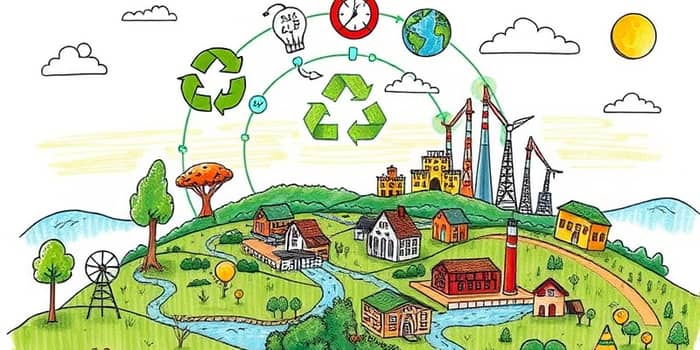
The concept of a circular economy represents a fundamental shift away from the traditional linear model of take, make, and waste. By redesigning systems, it seeks to keep products and materials in continuous use, reduce pollution, and regenerate natural ecosystems.
Transitioning to this model requires not only innovation in product design and resource management but also a robust financial framework. Circular economy finance plays a crucial role in funding projects and companies that embody principles of resource efficiency, product life extension, and closed-loop systems.
At its core, the circular economy aims to decouple economic growth from finite resource consumption. Instead of extracting raw materials, producing goods, and discarding waste, a circular system emphasizes reuse, repair, remanufacturing, and material recovery. This approach promises to unlock new value streams while preserving ecosystems.
Circular economy finance refers to any financial instrument that directly supports or refinances businesses and projects designed around these principles. By directing capital toward sustainable models, investors can help shape a more resilient and resource-efficient future.
Since 2018, industry-led guidelines have provided a clear process for evaluating and managing circular investments. These voluntary guidelines promote transparency in how funds are used, ensuring projects genuinely adhere to circular models.
Global standards, such as the Harmonized Guidelines developed by leading institutions, further refine sector-specific metrics and taxonomies to measure impact and maintain integrity in financial markets.
Financial innovation in this space spans a variety of instruments. From circular bonds issued to fund material reuse initiatives to equity funds focused on zero waste startups, the landscape continues to diversify. Blended finance and structured loans have also emerged, mobilizing public and private capital for large-scale projects designed as financial instrument exclusively applied to circular solutions.
Since 2019, investors have poured more than three hundred fifty billion dollars into circular solutions. This momentum reflects growing confidence in business models that reduce dependency on virgin materials and embrace ring-fenced to circular projects for accountability.
Adopting circular strategies unlocks both economic and environmental benefits. Companies can lower costs through resource efficiency, open new revenue from product-as-service offerings, and enhance brand reputation by reducing waste and emissions. These approaches demonstrate decoupling growth from raw materials while fostering resilience.
Financial institutions can construct portfolios that are not only profitable but also align with global net-zero goals, contributing to a more resilient global economy.
The transition requires collaboration between public and private actors. Leading organizations have stepped up to define principles, track progress, and develop tools that guide investors and companies alike.
Regional banks, consultancies, and research institutions continue to refine best practices and monitor performance, ensuring that capital flows support genuine circular outcomes.
Despite strong momentum, several obstacles remain. Many traditional financial instruments are ill-suited to fund long-term circular projects. Supply chain complexity can hinder material traceability, and standardized metrics are still evolving.
To overcome these challenges, stakeholders should focus on four key actions: policymakers can implement supportive frameworks and incentives, financiers must integrate circular criteria into every investment decision, companies need to rethink product design and embrace closed-loop models, and collaborators should share data and best practices for continuous improvement.
By aligning incentives and fostering cross-sector partnerships, the ecosystem can generate multi-trillion-dollar untapped market opportunities and ensure long-term viability.
The circular economy is poised to scale rapidly. As more capital shifts toward sustainable solutions, we can expect a reinforcing cycle where success stories attract further investment, and new innovations emerge to tackle remaining gaps.
Emerging tools like the Circular Economy Investment Tracker and robust circular KPIs will provide clearer visibility into the performance of investments. This transparency will fuel further confidence and drive adoption.
Ultimately, by financing the circular transition, investors and businesses contribute to a prosperous, resource-efficient world. This movement represents not just a change in how we manage materials but a deeper commitment to intergenerational equity, ecosystem health, and shared prosperity.
References