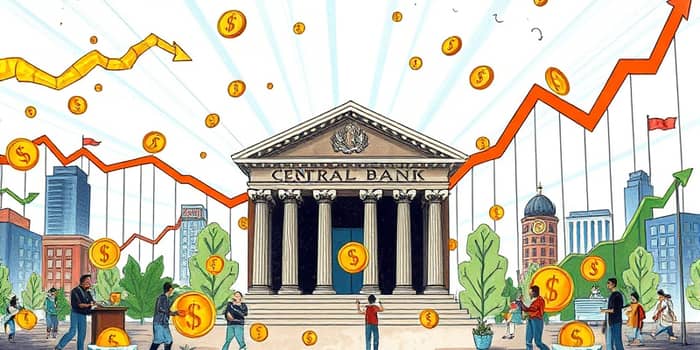
Monetary policy is one of the most powerful levers a central bank holds to influence the economy’s trajectory. By steering interest rates, controlling the money supply, and communicating future intentions, central banks shape everything from employment levels to price stability. Understanding these actions can empower individuals and businesses to make informed financial decisions.
In the United States, the Federal Reserve operates under a dual mandate: it seeks to achieve maximum employment and stable prices, while also fostering moderate long-term interest rates. In pursuing these objectives, the Fed employs a variety of traditional and modern tools, each with its own strengths and limitations.
At its core, monetary policy aims to manage aggregate demand and ensure that economic fluctuations remain within healthy boundaries. When demand outpaces supply, inflation pressures build; conversely, when demand falters, unemployment can rise. Central banks adjust their tools to smooth these cycles and guide the economy toward sustainable growth.
Price stability is essential for preserving purchasing power, while economic growth underpins job creation and rising living standards. By balancing these priorities, central banks help maintain confidence in financial markets and foster conditions conducive to long-term prosperity.
Historically, central banks relied on three primary methods:
Open market operations involve buying and selling government securities to adjust the banking system’s reserves. When the Fed purchases Treasury bonds, it credits banks’ reserve accounts, expanding the monetary base and encouraging lending. Selling securities has the opposite effect, reducing the money supply and dampening spending.
The reserve requirement sets the fraction of deposits banks must hold in reserve. Lowering this requirement frees up funds for lending, while raising it constrains credit creation. Although this tool has powerful effects, changes are infrequent due to the potential for significant market disruption.
The discount rate is the interest charged by the central bank on loans to commercial banks. A lower discount rate incentivizes borrowing and bank reserves expansion, while a higher rate makes borrowing costlier, discouraging excess lending. In practice, open market operations have become the Fed’s most precise instrument.
Over recent decades, the Federal Reserve has expanded its toolkit beyond traditional measures. These modern instruments allow for greater flexibility and precision in managing financial conditions.
The Federal Open Market Committee (FOMC) sets the target range for the federal funds rate, the benchmark overnight rate banks charge each other. To keep this rate within its target range, the Fed adjusts three administered rates—interest on reserve balances, the overnight reverse repurchase rate, and the discount rate. Open market operations are executed daily to maintain ample reserves. Administered rates provide upper and lower boundaries, forming a corridor for short-term market rates. This framework ensures that policy changes transmit quickly through the financial system, guiding borrowing costs for households and businesses.
By easing monetary policy—buying securities or lowering administered rates—central banks push down borrowing costs, stimulating investment and consumption. Conversely, tightening policy by selling assets or raising rates curbs excessive spending, helping to contain inflation.
Such actions ripple through mortgage rates, business loans, and credit card APRs, directly impacting consumer budgets and corporate plans.
During the 2008 financial crisis, the Fed deployed unconventional measures, such as quantitative easing, to inject liquidity and stabilize markets. These large-scale asset purchases lowered long-term rates when traditional tools had reached their limits.
In response to the COVID-19 pandemic, the Fed again implemented aggressive easing, cutting interest rates to near zero and expanding its balance sheet to support credit flows. As inflation surged in subsequent years, a series of rapid rate hikes aimed to restore price stability, demonstrating the Fed’s ability to pivot fluidly between easing and tightening modes.
Clear communication is a central bank’s silent but powerful tool. Through press conferences, policy statements, and economic projections, the Fed shapes public and market perceptions, influencing spending and investment decisions. Forward guidance, in particular, offers insight into the likely path of future policy, anchoring expectations and reducing uncertainty.
The intricate dance of central banking—balancing economic growth with price stability—underpins the health of financial systems and everyday life. By mastering the language and mechanisms of monetary policy, individuals and businesses can make strategic choices that align with broader economic trends. Stay informed, watch policy signals closely, and harness the power of knowledge to navigate the waves of economic change with confidence.
References